Thursday, 20 March 2014

How to Write and Illustrate a Picture Book (Part 5 of 6)

Picture Book Illustrating Course Part 2
Composition and Narrative


Last week we looked at the importance of style and characterisation in picture book illustration. This week I'm going to waffle on about the other two things that make a winning illustration portfolio - composition and narrative.

The point of picture book illustrations are not (just) to add decoration to a written book, they’re there to convey not only the overall message and atmosphere of the book (style), but also, more practically, to tell the story. It is very rare that the words alone tell the story in a picture book - indeed often they don’t even make sense separated from the illustrations - the two work in tandem.

So part of the illustrator’s job is to decide which bits of the story need illustrating - what are the key moments, and then decide how best to portray that moment in a single frame - much like a film director - you decide on the angle of view, the composition, lighting and key action necessary to enhance and add to the drama of the narrative.

Composition

Most picture books are 32pages long - with end papers, title pages etc. that usually leaves 12-14 double page ‘spreads’ - so each story needs to be broken down to , say, 12 ‘scenes’ - but it's up to you how to ‘shoot’ the scene.

Practical things to bear in mind when composing your illustrations;
Size - ‘trimmed page size’or 'tps' is the final size of the page. Every publisher has 1 or two different standard page sizes their books adhere to - when putting together images for a portfolio measure a few books first to see what kinds of size/proportions are standard and work to those. An A4 -sized and proportioned piece looks amateurish.
Bleed - All publishers require the illustration to carry on outside of the tps, to allow for movement and discrepencies when the pages are being cropped and also to allow the designers to move your illustration around on the page a little if desired. If you're undertaking a commissioned piece the publisher will specify how much they require but it will be at least 5mm . They also won’t want any important elements within 5-10mm of the edge for the same reason.
Gutter; The crease down the centre of the spread - you MUST bear this in mind for your composition - there should be no detail on or too near the gutter.
Text placement - you must leave enough room for text - normally more than would allow the UK text as other languages take up much more room!
So... you have your text, your page size, your character sketches, now you need to plan your book out...


Storyboards
Storyboarding is essential part of planning a picture book. Telling a story in 12 spreads is an art that requires you to tie the elements of pace, composition and colour together - storyboarding makes that possible and lets you see at a glance how to improve these elements.

Can be very rough and sketchy or very detailed - everyone works differently but the storyboard is the time to try out different compositions, different text placements, pacing, even colour schemes.

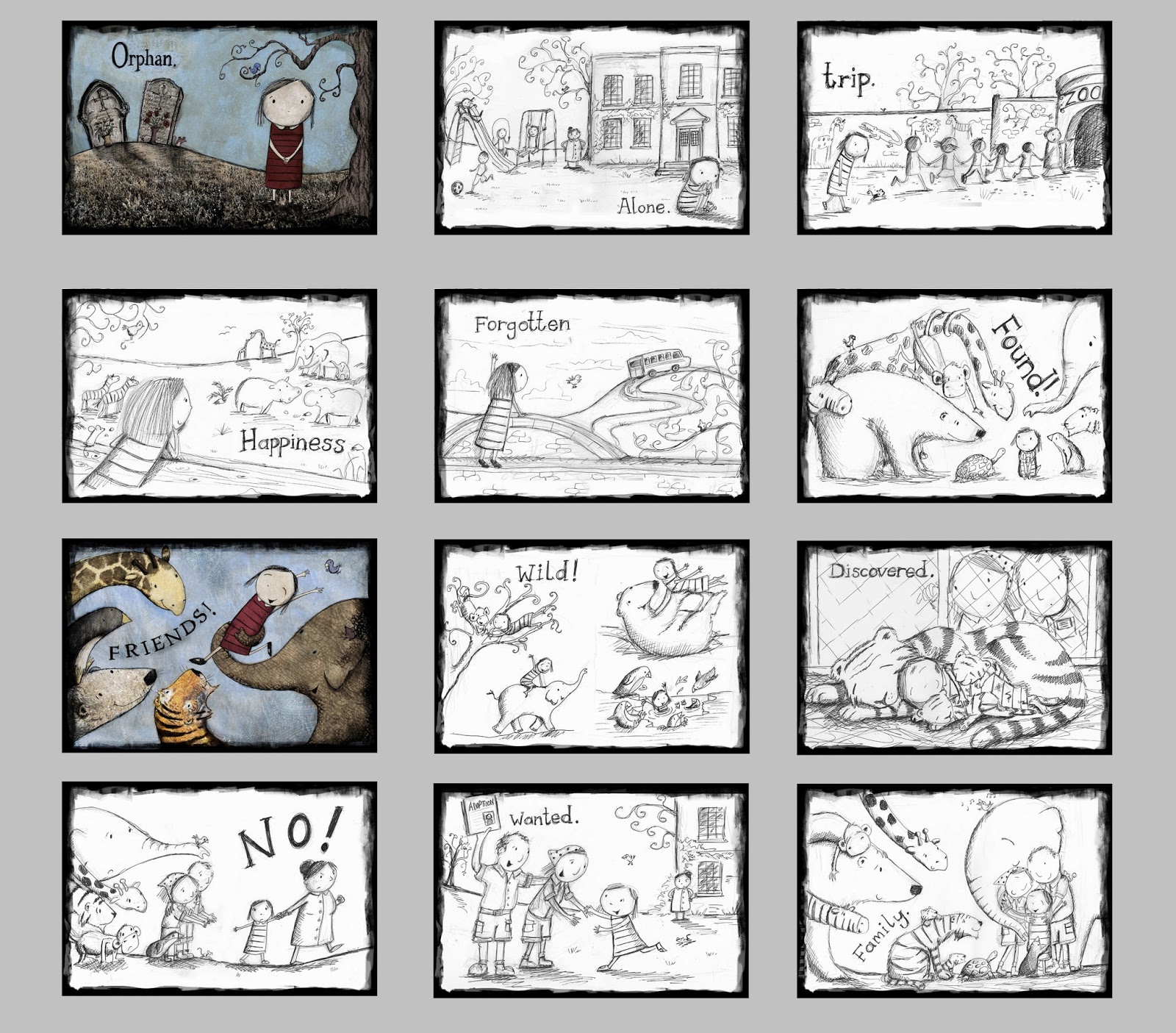
Basically, draw 12 rough rectangles for your 12 spreads and start sketching up rough ideas for compositions on each spread, eg.

Use this method to try different compositions for the same spread;


So what makes a good composition?


- Visually appealing
- Helps (rather than hinders) the narrative
- works with the text
- makes good use of the space allowed - including white space, the gutter,
- Varied within the book - close-ups, different angles, viewpoints, full page scenes or small spot illustrations or 'vignettes'
- Action - not static - either emotion or action conveyed to the reader. Nobody wants to see two character in conversation for spread after spread in a book. Vary it. If there's no excitement in the text, create some in the illustrations.
Try to get movement, action and exaggerated emotions into your spreads - and try to get accross what is happening with or without the text. I hope this 'submarine poop' spread from 'Mr Poopy Pants (Lion Hudson, due out in June) speaks for itself!

But much like when we looked at what makes a good picture book text the answer really only lies in other successful books, pouring over them, really looking at what makes the artwork work so well, when you do this you'll start to learn what works and what doesn't.
Never underestimate the use of colour - in my forthcoming book with Lion Hudson, 'Missing Jack' a difficult subject of the death of a pet is covered so on this spread, the saddest in the book, I wanted the colours to be very muted and the elements on the page to be sparse. Later in the book when  Toby starts to accept a new pet into his life the colours  pick up again, matching his mood.


Narrative
When  potential publisher looks through your portfolio one of the things they're looking for is great storytelling ability. Without reading the text can they already get a sense of the characters, emotions,  plot from your illustrations alone? Do your illustrations add more story to the text than was there to start with? Hidden depths for children, particularly older readers, to discover?

Two new spreads from Fat Fox book 'Happy Hooves' due out later this year. Both spreads are set in the same spot but I wanted to vary the colours of the background from spread to spread so that the book didn't feel static so in the second spread I've used patterns and colours from the pig character, the star of this scene, to colour bits of the background, I've also taken a drastically different 'camera' angle from the first spread to frame the scene. Artistic license is what it's all about in children's book illustration!

Activity
Draw 4 rough wide rectangles on your page with a line down the middle to denote the gutter.  Pick a random scene from this list and sketch out 4 different versions of it. Which works best? Why?


Homework
Work up a finished spread - can be a character or text you’ve been working on, something fro the list above, or a classic nursery rhyme or favourite book from your childhood (think 3 little pigs, Little Red Riding Hood, Goldielocks,  etc... but maybe with modern spin!) 

Remember to;
design your characters first
plan your composition first - think how you could improve it
do a pencil rough before going to colour

Extra homework if you have time.... storyboard an entire book - again, either your own or a classic, think in terms of 12 spreads.


NEXT WEEK: How to put together a plump, beautiful and irresistible portfolio and market your work to needy greedy publishers.

Sunday, 9 March 2014

How to Write and Illustrate a Picture Book Part 4 (of 6)


Picture Book Illustrating Course Part 1
Style and Characterisation


Ok so it's been a bit more than a week since our last session but obviously that's because I'm such a warm and understanding teacher I just knew you'd want a little longer to complete your last homework assignment and take in everything so far...

it has nothing at all to do with the fact that I forgot... a-hem...

and I've been busy working on new projects, like this;


Anyhoo, on with the lesson... quiet at the back...

We’ve spent the last three sessions looking at writing children’s picture books and now we’re going to concentrate on illustrating picture books - whether or not you intend to write them as well. In just three sessions I won’t have time to go into specific techniques and I can’t hope to cover an entire degree course but hopefully it will give you a good starting point from which you can develop your own work.... I’m completely self-taught (my degree was in Philosophy - not a natural path into book illustration!) and I believe that, as with writing,  if you begin to know your field and know what works and what publishers are looking for you can, with time, patience and a whole load of practice,  you can hone a more self-critical eye and start to shape your own work into something a publisher would be desperate to get their hands on.

Illustrating children’s picture books is a slightly less competitive field than writing children’s picture books as the skill set is more specific - you have to be able to draw! Where as with writing, everyone can string together a sentence so it’s not such a leap to believe you can write a book, with illustrating people tend to know whether they have artistic skills or not and would only pursue such a career (one would hope) if they do. I’m presuming in his course, therefore, that you have some kind of artistic skills to begin with! If not, take a basic beginners art course and learn to draw first.

BUT whilst it is not quite as competitive as writing them, illustrating picture books  is still an inCREDibly competitive field with hundreds of graduates churned out each year from illustration degree courses all with one aim - to get published! What I believe is sometimes lacking, however, in illustration degree courses is the knowledge on how to actually mould your work into something commercial enough for a publisher to want but unique enough to get noticed.

There are 4 things publishers are looking for in illustration samples; great....

Style            - what your work looks like! medium, feel etc.
Characterisation    - strong appealing characters
Composition    - using the page and text/image placement to best affect
Narrative        - telling the story through pictures

This week we’re going to look at Character and Style, next week Narrative and Composition and in the final week we’ll look at practical tips on what a publisher wants to see in a portfolio, how to send off samples, what to do when you get your first commission etc.


Style
- To be successful you need to develop a style that is original and instinctive.
- It's impossible to say what publishers are looking for at any one time but suffice to say they know it when they see it!
- Rather than setting out to impress find a style that comes naturally to you.
- Look at your own abilities and find out where your strengths lie and perfect that style
this comes over time - you can’t force it - and it’s not going to happen in three weeks!

Activity
It is arguably impossible to become a great artist without first studying the greats so your ongoing homework is to spend time in libraries/book shops/on line looking at what’s currently out there... not with a view to copying them but to know what you’re up against and the standards expected. Your work needs to be as good, if not better, than what is currently on the shelves if it is going to stand a chance of being published.

When you look through these books do NOT read them at first, instead try to just look at the images and consider the following;
- style, characterisation, medium, narrative, composition etc. And if you can, fill out (or at least think about) the attached question sheet with each book so you really start to learn what makes good book illustration and why.

How to find a style??
- Use a sketch book and sketch freely with no particular style in mind - popular styles are often those that retain that fresh instinctive flow captured in sketchbooks.
- sketch children and animals
- go to the zoo! Great place to come up with new characters.
- Start off sketching a subject accurately then condense that sketch down over and over again to something more characterful and less fussy. Try different eyes, expressions, clothing, exaggeration of elements, softening lines such as an elbow into something more fluid... whatever works... just experiment
- analise your sketches to see what you do best and build on that. Then try to colour up a sketch in whatever medium comes naturally to you
- don’t try too hard - don’t view the final artwork’ as something separate from what you do when you sketch or doodle as you can run the risk of over-working your final piece and making it static.
- Think about what medium to use - what will come naturally to you.This could be...

- Line and wash (gouache,  water colour, acrylic etc. This is traditionally the most widely used style.)
(Chloe and Mick Inkpen's 'Zoe and Beans')

- Thicker paint - acrylic,oils
(My book 'Milo's Pet Egg', acrylic)
- digital
(Spread from my as yet unpublished work  ' Jungle Mumble' - Illustrator and Photoshop )

- pastels


(Tina MacNaughton 'Snuggle Up Sleepy Ones')
- collage, mixed-media

(Lauren Child 'I will Not Ever Eat a Tomato')
- coloured pencils

(Raymond Briggs 'The Snowman')
- a mixture of the above - anything goes really it’s the end result that matters not the journey getting there!

When you've found your medium practice, practice, practice! You can only get better.

Characterisation

Character Development
- A successful character must charm and intrigue readers.
- Not necessarily cute, but certainly visually appealing and attractive in some way
- The main character will probably be on front cover and publishers are always thinking about the possibility of merchandising, licensing, tv rights etc. which are always looking for interesting, loveable, eye-catching new characters.
- Again, start with your sketch books - there are a million ways to draw a pig, a cat, a boy, find a way to make yours unique.
- EYES are very important!! Look at other artists to see how they draw eyes.
- Think not only about your characters looks but about his or her personality and how that can be conveyed in your illustrations.

(One of MANY pages from my sketchbook playing about with characters for my book 'Missing Jack'. Here's the final cover illustration;)


ACTIVITY
Come up with a monster character. - think cute, appealing, fun, funny.... fill a couple of pages with different monster sketches, don't stress over each one too much, just loose initial ideas. Then choose one of your monsters and draw/trace his outline over and over and experiment by drawing the eyes differently on each one, dots, large circles, realistic eye shape, close together, far apart, large, small etc. etc. and see what works for you.

Character Consistency
One of the main skills needed in a book illustrator is to be able to not only design a great engaging, appealing character but to then be able to draw it from different angles, doing different activities, with different emotions and in a variety of settings all the while keeping it consistent and believable. This takes a lot of time and practice! So get practicing.

Character sheets
Often publishers will ask to look through your sketch books just to see if there’s any possible characters to work on, and then they may ask for a character sheet - either the same character in different positions, or with slight variations such as different eyes etc.)
(A fox character sheet from a previous book of mine.)


Homework - Come up with 2 character sheets.
One with different possible ways to draw the same character, like your monster,  (chose a character either from the book you’ve written, or a made up book, or an existing tale) and
another with your chosen favourite character from the first sheet in different positions like my fox sheet above, - front, back, side, jumping, sitting, from above, walking, dancing etc. etc.! Give your character a name and a sentence or two on his personality.


Enjoy. And come back next week when I’ll be banging on about composition and narrative.


Tuesday, 25 February 2014

How to Write and Illustrate a Picture Book Part 3 (of 6)

Picture Book Writing Course Part 3
How to Get Your Book Published


In the first two sessions we learnt what makes a great picture book and how to write one. In this third session we’re going to learn how to get it out into the world in the form of a real live BOOK.

Before you even consider this step though spend as MUCH time as possible edit, edit and editing again your work! Then put it in a drawer for a week, do something else for that week (this could be writing your next book) then get it out of the drawer and edit again with fresh eyes. Read it aloud. Read it to kids. Get other people who you trust have some writing/story telling skills to read it. Then edit it again. And when and only  when’s it’s PERFECT, submit it to publishers!

Here’s what you include in your submission package;

1. Covering Letter

- No longer than half a page of A4
- Set it out formally with your address, phone number and email clearly written (maybe a logo if you have one, especially if you’re an illustrator as well), their address , date etc.
- Find the name of person to write to (phone the publisher) OR address it to the ‘Commissioning Editor’
- Be BRIEF and PROFESSIONAL and include;
- WHY you’re writing to THEM (if possible flatter them - why their current book list is great etc.!)
- A brief description of your book - why it will appeal to readers - just a sentence to entice them to read on.
- Possibly include your target audience age, possibly a word-count
- A brief statement about you (Truth is they don’t care if you’re a primary school teacher with 12 kids of your own, an a-level in English Lit and a desperation to see your name in print. They only want to know that you are professional and approachable and the work will then speak for itself.)
- Factual housekeeping stuff - ‘I enclose a stamped SAE...’ and if you’re sending it to more than 1 publisher at a time write ‘this is a simultaneous submission’ If including illustrations say whether or not you are happy for your writing/art  to be considered separately.
- Closing statement ‘Thank you for your time and consideration’,
- Sign-off - sincerely/faithfully etc.


Here's a quick made-up example of one for my book Naked Trevor (I actually already had an agent so never had to send Naked Trevor out myself but you get the idea. Btw, If you want an agent the submission proceedure is very similar to a publisher, send them your manuscript and a covering letter briefly saying why you want to be with them and why they should be with you. Think of it as literary speed dating. )


- EDIT your cover-letter!! Make sure there are NO mistakes - names, spelling etc.
- Don’t be gimmicky (it won’t help your proposal if it’s written on pink perfumed paper and delivered by a clown) - it can look amateurish. This is your business proposal, not some frivolous hobby you want validated.

2. Manuscript
- Cover page - Nothing fancy, no images, just book title, your name, contact details, word count
- The main text should be typed in a plain black font (Helvetica/Times etc. - nothing fancy or distracting) at 11/12 pts
- Double-spaced (covering letter as well)
- Split in to double - page spreads. They need to know you’ve thought about fitting it onto 12/13 spreads and this helps them visualise the flow of the story. You can number your text for each page but I prefer to just use a short dividing line between each spread.
- Do NOT include illustrations unless you intend to illustrate the book. Commissioning Editors are very good at imagining the illustrations to accompany the submissions they read and they will want to be the one to pick an illustrator from their books to accompany your text should they take it on. So PLEASE don’t include some illustrations done by your Uncle who likes to dabble in watercolours of a weekend.
- Describe illustrations ONLY if necessary, i.e. If the text and the illustrations are purposefully at odds with each other eg. “What a peaceful day! Thought duck ” - illustration shows elephant with two large symbols about to be clanged together above duck’s head.” Or a book like Pat Hutchin's 'Rosie's Walk' where most of the action is visual and out of the main character's knowledge.
Use a smaller font in italics to do the describing so that it is not confused with the text itself.


- Header/footer should have your name and phone number/email
- Some publishers hate staples/ paperclips - some ask for it! Check. You can often find their submission guidelines on their website, or phone up and ask for them.

3. STAMPED self-addressed envelope  - Look at submission guides first - some (eg. WALKER) do not send mss back so ask for a letter-sized SAE only, others will want an envelope BIG enough for your manuscript and with appropriate postage on it. - Check first.

And then send it all off....

But who to??
This is where your first and ongoing homework comes in to play - visiting those libraries and children’s book departments in bookshops as often as you can and pouring over their wares. By doing this and getting in the habit of turning a book over and seeing who published it you will start to know who publishes what kinds of texts - and when you see a book in a similar style to your own, make a note of who published it and send your manuscript to them. Count how many spreads that publisher uses and tailor your manuscript to that number. Check their website to see if their submission guidelines are on there or even if they’re currently accepting submissions. Phone them to find out who to address your submission to. Do your research! Part of this research, by the way, should involve purchasing or borrowing from the library The Children’s Writers and Artist’s Yearbook - it has the relevant names and addresses of every publisher and agent, submission guides, articles with advice etc.

MULTIPLE SUBMISSIONS?
I say go for it. There used to be a no-no on multiple simultaneous submissions, but frankly if you send it out one at a time you will have to wait 3 - 6 months to hear back from a publisher and the chances are the first few won’t pick up your text so before you know it a year or two has flown by and you’ve only sent it to 5 publishers. I think publishers now appreciate this and it’s more widely accepted but check they don’t mind first and always let them know in the covering letter. Oh and if you get an offer from a publisher let the other publishers you’ve sent it to know immediately. I also wouldn’t send to more than 4 publishers at a time, it just starts to seem rude if you’re indiscriminately sending it out to all publishers everywhere rather than picking the ones you love and think might be interested in your book. Plus it gets confusing.

And then... wait......  and wait.....
Check their submission guidelines for waiting times - as I say, this can be up to 6 months. But usually it’s ok to write again 3 months later very briefly, asking if they’d had a chance to look at your manuscript sent to them on (date) and again saying you’re looking forward to their reply! Don’t get pushy - don’t phone after a week hysterically begging for some feedback - remain professional throughout. Hide the tears.

Keep a record - THIS IS IMPORTANT. The chances are you will be sending different manuscripts to different publishers over several months so you must keep records - include the dates sent, to which publisher, when a follow-up letter can be sent, the response received. Most authors worth their salt have a tray of rejection letters from their early days. It’s nothing to be ashamed of, just badges of honour!

So what do you do while you’re waiting for your replies?? WRITE the next one!! Keep the ideas coming, keep sending out the submissions, learn from publisher's comments and rejections. You’ll soon find that whilst you thought your first idea was the best you’d ever have your new ideas far exceed it and are just getting better and better the more you write. Write for the love of writing, not for the love of getting published. Enjoy.

Next week - How to ILLUSTRATE a picture book part 1. See you then.

Monday, 17 February 2014

How to Write and Illustrate a Picture Book Part 2 (of 6)

Picture Book Writing Course Part 2
How to Write a Picture Book


Last week we talked about how difficult the industry is to get into and why, and what makes a good picture book.

Part of your homework was to look at a selection of picture books (I’m afraid this homework is ongoing for the rest of your life if this is your chosen career - you have to keep on top of what’s being published and by whom, and what’s selling well and why). Through looking at successful picture books, although they vary wildly, there are certain ingredients which pop up time and time again which , if your book is going to be successful, you need to know.

So what makes a great picture book?

Here’s a recap of our checklist from last week and then I’ll break down some of the points more clearly;


- Original
- Well written
- Beginning, middle and (great) end
- Fit nicely into 12/13 spreads with action on each spread
- Attractive and entertaining to children and adults
- Children/main character solving their own problems, not adults stepping in to 'save the day'
- A Simple idea told clearly
- Engaging characters


Original
Ok so it has been said that there are no original ideas, others have said there are only 7 fiction plots, and my favourite view on the matter was from Russian writer and awesome beard owner Leo Tolstoy who said that; “All great literature is one of two stories; a man goes on a journey or a stranger comes to town.” But there are always new ways to tell stories, new hooks, inventive narratives, uniquely engaging characters, new plot twists and so on and so on. There are many ways to make your story original and that’s what you should be looking to do.

Well written - just because children are going to read your story does not mean your story should read as if it has been written by a child! Grammar, spelling, punctuation are all important as are beautiful sounding turns of phrase. A picture book has few words so those words should be picked carefully until, even when it’s not a rhyming text, it reads almost like prose.

Some good linguistic and story-telling tricks:

Alliteration - Can be humorous and an excellent way of exploring sounds but don’t over-do it and don’t do the obvious just for the sake of it - ‘Harriet’s Horrible Hair day’ is a great title, “Leo the Lion’ is not.

Think in 3s - 3 repeated words, phrases, situations always works well and adds rhythm and predictability which children like without going on and on and getting dull. Think Goldilocks and the Three Bears, or The three little pigs and even the wolf’s phrase, ‘I’ll huff, I’ll puff, I’ll blow your house down.’

Page-turners
A book’s main design feature to be explored and exploited is the page turning! Encourage page-turning by ending the pages on a cliff-hanger, end the page on a ...but...  ...and then....    ...or..... ,or with something that makes the reader ask ‘what happened next?’. - All adds to the suspense and excitement!

RHYME - great, if you can do it, but it has to be outstanding to be in with a chance of publication! If you do use it make it fresh, don’t try to sound like Dr Seuss - it’s been done! But be warned - many publishers refuse rhyming text because it’s so difficult to sell it in countries speaking different languages - not only have they got to get it translated, they’ve got to get it translated by a poet who can make the story work in rhyme all over again! Unless it’s your thing I would avoid it as a beginner.

Beginning, middle and END. It seems obvious that a story should have these three things and yet it is surprising how many first time picture book writers miss one or two of them out! The beginning in a picture book should be straight in - no messing about, no descriptions, no “Polly was a 4 year old girl with pigtails and a yellow dress.” We can see that in the picture!! It’s a picture book! We want to be thrown straight into the story - captivate us on the first page - what problem is the main character trying to solve, what conflict, known or unknown to him, is he facing?  In the middle there should be a progression of the story, one thing leads to the next pleasingly, the character’s attempts at solving the conflict get him further into trouble, or the characters he meets lead him further into the situation etc. And then the end - this must tie up the loose ends, bring the whole thing to a satisfying conclusion, and will preferably involve something unexpected or some kind of twist (we’re not talking Sixth Sense proportions here, just some extra unforeseen something which makes the reader smile, gasp, laugh or even jump.) Don’t rush it or drag it out.
There is an old playwriting adage about beginnings, middles and ends that goes, “Get your hero up a tree, throw stones at him, then get him down.” Brilliant.

Fit nicely into 12 spreads with action on each spread
Picture books are mostly 32pp long and taking away end papers, title pages, copyright pages etc. you’re normally left with 12-14 double page spreads (depending on the publisher) I normally work with 12 so when writing a book I am always thinking how it would fit over those 12 spreads - making sure there is enough action to fill each spread and not too much that I have to cram it in. Get into the story on the first two spreads, play out the narrative in the next 7 spreads, twist and conclude in the remaining 3. But every book’s different of course!

Attractive and entertaining to children and adults
Adults publish the book, edit the book, buy the book and read the book (to their children)! So often the most successful books amuse the adults just as much as the children - Olivia by Ian Falconer is genuinely funny, as is I Want My Hat Back by Jon Klassen , Harry & Hopper is genuinely sad for all ages, The gruffalo truly exciting and pleasing to all ears, and so on. Make the parents love the book and the children will too, but equally don’t underestimate your young audience - children will find things funny that you never thought they’d ‘get’, or see the sadness in things you thought were too subtle.

Kids solving their own problems, not adults
It’s important that the main child or child-like character is the one who solves whatever problems he may get into throughout the book (with the help of others is fine) - rather than an adult character stepping in and sorting it out for them.

Simple idea told clearly
Don’t be over-ambitious in your narrative or theme, keep it simple but interesting. You should be able to sum up and ‘sell’ your story in less than a sentence.

Engaging Characters
Make your characters stand out, but make sure your readers can identify with them. And a character on its own doesn’t make a story, it has to be the magical combination of great story and great character.


Ok, so we have an idea of what makes a good picture book so now we’re going to look more specifically at how to write one.

First - you need an idea!

Hope you all did your homework! Partly to show that ideas are ten a penny - they’re all around - it’s what you do with them that counts. If you’re stuck try thinking about;
writing for a particular child
starting with a character
starting with an incident
think about your own childhood
Look around you!
Or try thinking about themes - Classic children’s story themes:
Courage
Friendship
Loss
Growing Up
Belonging
Anger
Jealousy
Love

Avoid trying to impart a moral through your work though - children can smell a moral lesson a mile off and it usually pongs (subtle background themes can work - my books Just Because and Sometimes feature my daughter Clemmie who is severely disabled and in a wheelchair but importantly the books are not just about disability, and do not preach to children that they ‘must be accepting of others’, it’s merely a theme in the background of an otherwise fun, funny story about sibling love.)

The most common narrative which can fit within all these ideas and never goes out of fashion is this; a main character that readers can identify with and a conflict that needs to be resolved, and is by the end of the story.

It’s what you do with that idea that counts - how you make it original, how you shape it into a pleasing and perfectly formed picture book.


Here’s a few extra Dos and Don’ts I’ve come up with over the years through looking at what works and what doesn’t (there are exceptions to ALL of these but they’re a good general guide for someone starting out)


NEVER put in the words what can be told in the illustrations - never describe a character or setting as that’ll be in the pictures. Show don’t tell.

NEVER write about something country-specific or time-specific - stories about red london buses, or the 2014 Winter Olympics have a limited shelf-life and/or are limited to certain parts of the world.

ALWAYS keep the story flowing - your illustrator needs different action and/or scenery on each page to keep the viewer interested - this is a PICTURE book so think in terms of pictures.

NEVER use more than 1000 words (most are much less - mine are around 3-400 words)

ALWAYS remember you’re writing for kids - pay attention to them - notice what they like, how they talk, how they act and get in touch with your inner child!

ALWAYS stick to a consistent point of view - don’t start off talking about Charlie the puppy’s day and then cut to ‘meanwhile out in the yard Charlie’s sister Cheryl...’

NEVER talk down to the child - no preaching, no patronising - don’t worry even about vocabulary level when first writing the book, maybe consider later down the line.

ALWAYS read your story aloud after every edit - this will be how it’s presented to it’s audience and it needs to flow and have rhythm,

NEVER use cliches (eg. , excessive exclamation points!!!!!!!!, or over-exaggeration - it looks amateurish and often compensates for a lack of actual excitement in the story!

ALWAYS research - eg. if writing about animals, unless in a zoo, look into what animals actually live in the same habitat (so no tigers/lions living together),

ALWAYS make sure there’s story progression - each scene must build on the previous scene/s before story is resolved - some get worse and worse (, with others small victories are won along the way (Gruffalo, 3 little Pigs) Or if it’s an adventure make sure it’s moving towards or away from something (Where the Wild Things Are)


You have your idea, you know what works, so now to actually write the book - but how do you go about it?

This is based on how I work - you may do it differently!

1. I scribble down basic plot ideas - think of a vague beginning, middle, end,  include character ideas (even sketches), twist ideas, ideas for your first line. This is often the longest stage (Zoo Girl was at this stage for literally years before I managed to pin it down and mould it into an actual story that worked!)

Pace out the pattern of events over 12 spreads - either by numbering 1-12 down the side of a piece of paper and filling in the blanks or/and by using a story board or dummy book (fold 7 pieces of A4 - use spreads only, write your story description in each spread - also very useful at later stage for checking flow of the story)

3. Write the book! Use your notes and put in page breaks between each of the 12 spreads of text.

4. Finally and most importantly - edit, edit edit! Picture books use few words meaning that every words has a much higher importance, so has to be exactly right. If it isn’t necessary, cut it.
Shorten or remove any scene, section, word, paragraph, character, or sentence which doesn't move your story forward. Publishers are big fans of brevity!


Homework - Pick the best idea from your homework last week (or come up with a new one based on what you’ve learnt in this lesson!) and write a finished manuscript! Try to make less than 500 words and if possible Print/write/paste the text in to a dummy book to see if it works.

Next week - how to sell your masterpiece and see it published!

Monday, 10 February 2014

How to write and illustrate a picture book part 1 (of 6)

Before having my third (and FINAL!) child and finding that I no longer have time to brush my hair let alone do anything else, I used to run a 6 week evening course on how to write and illustrate children's books. Being a fan of reuse, recycle and re-hashing old material I thought I might blog the course so that anyone out there who might be interested in taking up this noble profession (which according to my husband amounts to little more than 'colouring in') can glean what they may from my musings. The first three weeks are how to write a picture book, the following three are how to illustrate one. Obviously this is, at best, a brief introduction to the discipline but I hope it might serve as a starting point for a few who may have the talent and inclination but be a little lost on where to begin. I was at that point 14 years ago when I started self-teaching myself by reading just about every article I could lay my hands on and quizzing any professional who didn't take out a restraining order.

There will be homework! If you chose to do it, great, if you want to send it to me for my perusal please do and if I get the time to get back to you then we'll both be doing well.

Picture Book Writing Course Part 1
What Makes A Good Picture Book

It's Tough!
True story; Dr Seuss was at a dinner party when he met a Brain surgeon, the brain surgeon said ‘oh, are you that guy who writes those little books for children? I’ve always thought that when I had a free afternoon one Saturday I’d love to write one. Dr Seuss replied, ‘ ‘Ahh yes, and I’ve always thought when I had a free afternoon one Saturday I’d love to do a little brain surgery’


I'm not suggesting that what I do is brain surgery (it's actually more like rocket science;)

but there is a misapprehension that it’s easy to write for children and get published. I thought so! Until the harsh realities and rejection letters beat my optimistic spirit violently down. The truth is that writing picture books is a particular artform with it’s own rules and requirements - it’s a craft that takes a long time to master - (and clearly I am in no way near to mastering it yet).
It is also an EXTREMELY competitive field. I spoke with a small publisher a few years back who told me they get 100 unsolicited (i.e. not through an agent) manuscripts a week - of which 2 a year might get published.  It took me 2 years of hard slog to get illustration work and 8 years of writing picture book manuscripts before one was published - and this is quicker than many.

So why do so many people think they can do it?
1) Every parent/grandparent/teacher/aunt with a grain of imagination has made up stories to adoring children and thinks they would be good enough to be published. Unfortunately kids love the attention of anyone making up stories for them whether the stories are any good or not. We all have the ability to make up a story, but this doesn't make us all writers. I can make beans on toast - doesn’t make me a chef!

2) People think their book will change the world! People often get into writing children’s books with projects they are truly passionate about - pets, family anecdotes or memories, or a moral they wish to impart and then take it terribly personally when they hit their first wall and refuse to compromise or take advice.

3)   People think it’s easy because unlike a novel, it’s short! But just because there     aren’t many words doesn’t mean there isn’t much story. Children's author Mem Fox once compared writing picture books to ‘writing War and Peace in Haiku’.
A slight exaggeration, maybe, but one of the most difficult books I've ever written is Zoo Girl - and it's told in only 20 words! But trying to get the story right first, with emotional ups and downs, cliff-hangers, a strong beginning, middle and end, character depth etc. and then condense that down and tell as much as I could in the pictures rather than the words was an immense challenge. It's easier to ramble. As this blog entry is proving.

4) People think it pays well - true if you have a big hit like The Gruffalo but this is exTREMEly unlikely and many books go out of print after their first print run so the writer gets no royalties and may be paid an advance of just £1000 - £3000.

Why do most people fail?
The fact is that most would-be children’s writers have no idea what they’re doing. They simply haven’t taken the time to learn about writing for children. Let's face it, you wouldn't try to fly a fighter jet without first taking flying lessons. So why do so many people think they can write a children's book without first learning how? (I admit this is a terrible analogy - no one, so far as I know, has ever died a horrible plummeting death from trying to write a picture book without the proper training, but you get my point.)

So what’s the secret? Simple - In order to get your picture book published, you MUST find out what publishers are after and then give them EXACTLY what they want. And, the good news is, children's book publishers are desperate for good children's books, because, as I’ve said, most of what they receive is rubbish!

Children’s books like anything else are a business (a really fun one, but a business none the less) and as such we need to be creating products which will be appealing to the target audience - not just the children (although they should ALWAYS be at the forefront of our thinking) but the publishers, editors, booksellers that all come before a child even sees it. Hopefully in this course you'll get a strong idea of what publishers want, and how to create it and present it to them.

It's also worth saying at this point that if you can overcome the odds, do the research and break into the business - it's one of the most rewarding, enjoyable and fun jobs around!

This first session is What Makes a Good Picture Book? - If you don’t know this, how are you going to create your own one?

The only way to do this is to research - know your market, love your market, visit libraries and children's departments in book shops, start collecting picture books that catch your eye (charity shops are a great source). If you don’t love children’s books, if you think they're beneath you, if you're scared of being stared at as you spend hours in the children's section of the library, leave now, this profession is not for you.

Different kinds of picture books:
 I regularly get emails from people who have written 'a children's book' and when I ask what kind of children's book and what age it's aimed at they're a bit stumped, or the material in no way goes along with the age they tell me it's aimed at so you need to learn the difference between... mass-market activity books, board and novelty books, Early Readers, picture books, YA novels etc. etc. You'll get to know these by visiting those libraries and bookshops again and seeing what's in each section, holding them, looking at the blurb on the back, etc.

In this course it's high-end trade Picture Books we're interested in - these are generally - 32pages, 12-14 full colour spreads, with full-colour, quality illustrations, and original tales told in less than 600 words.

But within picture books there are of course different genres, for example;
Humourous (eg. Dave, The Monkey With the Bright Blue Bottom, Olivia, Naked Trevor)

Action adventure (eg. Gruffalo, Where the wild things are, )
Snuggly bed-time story (eg. Guess How Much I Love you, I love you Daddy, Cub's First Winter)


and lots more besides, and many books of course span the whole lot. But it's worth thinking about what kind of book you want to write and which market you'd be aiming at.

Characters

Your picture book will need a main character and generally these are;
Children - the same age or a little older than the target audince (which for a picture book is usually between 3-6 but can be much wider)
Animals - usually young animals or an older animal with a child-like outlook
Creatures - monsters, fairies, robots etc.
Adults - very rarely the main character  (Percy the Park keeper is an exception but he looks quite chubby and child-like! There are other notable exceptions but i think best to avoid as your main character) ok to include parents, teachers, doctors etc. - Adults children have come across in their own lives.
Inanimate Objects - Again, there are notable exceptions but generally I would avoid writing your picture book about Simon the Stapler or Billy Banana. It's old-fashioned, it's dull, it's of little interest to publishers.

The important thing is your picture book needs at least one character the child reader can identify with - so whether it's a robot monkey or bespectacled duck make sure they make choices and deal with emotions like a 5 year old child would.

So what makes a book work well?
THERE ARE EXCEPTIONS TO EVERY RULE HERE by generally a great picture book must be;

Original - publishers are looking for a new hook or concept
Well written - we'll go into more detail about this next week but each word must be perfect.
Beginning, middle and end - Straight in, exciting progression, pleasing ending
Fit nicely into 12/13 spreads with action on each spread
Attractive and entertaining to children and adults
Children/main character solving their own problems, not adults stepping in to 'save the day'
A Simple idea told clearly
Engaging characters

GREAT ending

We will be looking at this list and going through it in more detail next week but for now;

Homework!

1. Look at a selection of (fairly recent) picture books and as you read them and study the illustrations  ask the following questions;

What kind of book is it (funny, adventure etc.)
What’s the basic plot?
What is the atmosphere of the book and how is that conveyed?
Why and how do the images and text work together?
Is the book appropriate for its audience? Why? Is there a character the child can relate to?
What is the child meant to gain from the book, if anything?
Is there an underlying message or moral to the book?
How does the narrative work - is there a definite beginning, middle and end?

2. Come up with 3 vague picture book ideas - include a main character and a rough plot line.

Next week - How to Write a Picture Book

Friday, 27 September 2013

Retro kids bedrooms...

I love collecting retro artwork and imagery for my kids bedrooms... here's a taste...

 In Clemmie's room... a poster from The Hambledon shop...
a wall organizer from byGraziela... (and of course a bit of Miffy)
In Benjy's  room...


 Owl wallpaper from Ferm Living and a monster I (pretty shabbily!) made out of some old tartan fabric.
 ...and another poster from The Hambledon shop;
And in Toby's room...
 Numbers and letter wall workboards from Isak.
 A 1960s Japanese painting I found for next to nothing on eBay...
 ...some wooden play cards from a 1950s 'picture lotto' game...
and some Vintage DC comics postcards.

Monday, 16 September 2013

Roger Duvoisin

Ok, so it's been a while but the summer has now well and truly left without leaving a note so it's back to it and I'm going to try to add to this weekly, yes, weekly from now on. Anyhoo, this week I'm celebrating the retro-charm of the work of Swiss-born American writer and illustrator Roger Duvoisin (1904-1980) - I've recently picked up a few of his books and they're all rather splendid, although my favourite has to be the gorgeously titled 'Hector Penguin'. Enjoy...


Blogging tips